Tuesday, September 16, 2014

Capacitors: All Things are NOT Created Equal - Part 2

There are many electrical measurements one can make on a capacitor to help you understand its behavior. Manufacturers of capacitors, for example, sometimes publish the ESR (equivalent series resistance) specification that indicates how much loss is incurred by adding this capacitor to the signal path. This ESR loss in a crossover network means that the power that should go to the driver is instead consumed by the capacitor and translated into heat. High-quality low ESR capacitors are typically more expensive to manufacture and are therefore usually not used in budget electronic devices.

By simply adding a capacitor to a crossover network, the output of the driver will be lower than without it. How much lower is a function of the ESR and the rated impedance of the driver. So it appears from this specification that capacitors with low ESR would be a good thing since it would allow the driver to be louder thereby permitting it to reveal more detail. However, not all capacitors are created equal and some with low ESRs sound absolutely terrible. So a combination of factors must contribute to why one capacitor design sounds better than another.

It is common for equipment designers to use DC-blocking capacitors between gain stages. Doing so permits the two gain stages from adding a DC offset that alters the uniformity of performance of the device, so this can be a good thing. But using a capacitor with a high ESR (i.e., a low-cost capacitor) can also alter (degrade) the signal. How much degradation occurs cannot be measured by standard THD and IM measurements (or the value of the added degradation is so low as to be considered insignificant) but its audible effects can be sometimes detected by the ear.

For example, one capacitor type with low ESR uses a mica insulator. Mica is inexpensive and provides excellent performance in high-voltage applications and in the radio-frequency band. However, mica capacitors in the audio band yields sterile and edgy sounds that significantly color the audio signal. Yet, measuring  IM/THD in an audio circuit provides no hint as to why this occurs. This same phenomenon occurs when using non-polar electrolytic capacitors.

So what gives here? What is it about this simple design (two conductors separated by an insulator) that makes such a huge difference in the sound? In Part 3 we will explore other physical properties that can give us a hint as to why this occurs. Until then, know that any capacitor in the signal path or feedback loop of any audio circuit can be viewed with suspicion.

Related articles:
The Vishay 1837 Review and Modification
Bypass Capacitors
Mundorf Supreme Capacitor Review - Part 1
Mundorf Supreme Capacitor Review - Part 2
Capacitors: All Things are NOT Created Equal - Part 0
Capacitors: All Things are NOT Created Equal - Part 1
Capacitors: All Things are NOT Created Equal - Part 2
Capacitors: All Things are NOT Created Equal - Part 3

Yours for higher fidelity,
Philip Rastocny

Skeptics are essential to keep us sane; skeptics do little to keep us inspired. Philip Rastocny, 7-16-2014

I do not use ads in this blog to help support my efforts. If you like what you are reading, tell your friends and please remember to reciprocate by purchasing some of my highly affordable works at Amazon.com. My titles include:
Copyright © 2015 by Philip Rastocny. All rights reserved.

Friday, September 5, 2014

Denon and Marantz in dire financial $trait$

What the heck is going on to high-quality audio? First Pioneer announces its decision regarding their Elite product line and now D&M Holdings (owners of Denon and Marantz), are in the midst of a financial disaster? It appears that the dominoes are beginning to fall - again.

The high-end never has adhered to what could be termed as a "good business model" seeking to do what other exotic product manufacturers do - captivate the elite with tantalizing toys. If this disasterous pattern begins to spread, it could impact other high-end offerings such as motorcars, jewelry, art, and who knows what else.

Many folks just claim that they missed the mark in product strategy and this could be true. There is a fine line between selling enough of something to stay afloat and offering a product that the elite will buy. Once you dip below this imaginary line, you enter the realm of mass marketing where profit is measured in a very different way spread across investors and held accountable to a board of directors.

Mass marketing is the antithesis of the high end and we will never hear a "thoroughbred racehorse" from a company concerned more about profits than about quality. But yet we live in a changing world where profits must be considered if one is to stay in business. Such is the dilemma. How is this apparent dichotomy addressed?

In the 1970s, there was a rash of similar failings where the market shifted gears to "good enough" from "the best possible" and few subscribing to the latter view survived. But now, those who even subscribed to the "good enough" model also seem to failing. So what is the answer? Is the high-end doomed? Will only those who support a few of the elite manufacturers decide who survives and who does not AND will those surviving companies truly continue to develop new technologies and higher fidelity? It remains to be seen.

Survival is the cornerstone of any company and one must figure out how to adjust or compromise to do so. If such a adjustment does not prove profitable, then failure is around the corner. If a compromise does not detract from a quality offering, then such a decision was a good one. But how does one know where or how to compromise? Good question to which there is no cookie-cutter answer.

However, if one looks at how any start-up company evolves from its modest founders working in a basement or garage with little overhead and operating expenses, to a facility that rents office space and hires staff to handle specific responsibilities and compartmentalized issues, herein could lie the hint. Once a company grows to a certain critical size, the cost of the infrastructure becomes a burden and salaries the major drain on the budget. Keeping head count under control seems to be one of these deciding factors.

A friend of mine saw this handwriting on the wall decades ago and decided at that time to reduce his staff and focus on only a few things. Literally his company shrank from 30 people to 12 and these 12 do more than the other 30 ever did. He still looks for ways to be more productive but he keeps his staff lean and involved by giving each of these folks a lot of responsibility. The other key is his rule of never involving more than two people in any meeting. He has found that egos and ulterior motives are minimized and the best decision is usually reached. I wonder what lessons his model could be applied to the high-end?

I am not a business person only a lover of sound. I yield to those who have knowledge of how to succeed and survive and what I say may be completely off base. But like subjective evaluations, time reveals the truth about business decisions. Obviously, D+M Holdings have not made the right business decisions, choices, adjustments, compromises, and changes, and as a result Denon and Marantz are soon to become dusty names of the past. Downward spirals from wrong decisions are inevitable but so are the right decisions a sign of success.

For the moment, the high-end market appears to be shrinking and many more prestigious names may also disappear. But one thing I know, from the ashes upstart companies will be reborn and ideas will survive. New companies with smaller overheads will enter the market and their offerings will replace those of the stumbling giants. It is time for change. Hang on...the dust will eventually settle. I predict that like the proverbial Phoenix, huge changes in the high-end is about to be observed.

Yours for higher fidelity,
Philip Rastocny

Skeptics are essential to keep us sane; skeptics do little to keep us inspired. Philip Rastocny, 7-16-2014

I do not use ads in this blog to help support my efforts. If you like what you are reading, please remember to reciprocate, My newest title is called Where, oh Where did the Star of Bethlehem Go? It’s an astronomer’s look at what this celestial object may have been, who the "Wise Men" were, and where they came from. Written in an investigative journalism style, it targets one star that has never been considered before and builds a solid case for its candidacy.

http://www.amazon.com/dp/B00QFIAC3G

My other titles include:

Copyright © 2015 by Philip Rastocny. All rights reserved.

Wednesday, August 27, 2014

Transistor Tweak

I have a McIntosh MC-2100 power amplifier I have been tweaking now since I purchased it new back in 1972. It has undergone some serious modifications including the replacement of all internal wiring and converting it to a true single-point ground scheme (that took a while) back in 1984. After performing that amount of major surgery, this amplifier sounded REALLY sweet and its purity has been locked firmly in my sonic memory ever since. As time passed, this sweet sound gradually faded and while it still sounded "good," it just lost that magic it had right after the wiring upgrade.

McIntosh MC-2100 Amplifier, Power Transistors on Heat Sinks

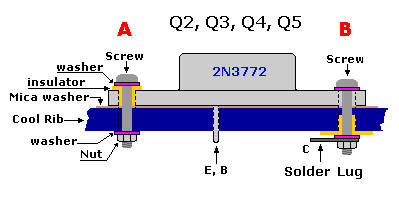
This generation of solid-state audio amplifiers used the TO-3 style power transistor sandwiched to the heat sinks in the usual manner: insulator between the transistor and heat sinks and screws holding the transistor to the socket.

Typical TO-3 Mounting Hardware Style 1 (screws not shown)

Typical TO-3 Mounting Hardware Style 2

Any well-respected high-end enthusiast will routinely clean off his/her interconnect cable and speaker cable connections with anti-oxidation cleaners; the contact resistance rises as these connections oxidize. That quality sound you once valued begins to fade in proportion to this corrosive effect. A quick cleaning treatment usually restores the music to its previous glory (tube pins and sockets suffer a similar fate).

Taking this contact cleaning thought another step further, I tried something not so drastic as to clean the contacts of these transistors (mine are soldered into the sockets), I merely loosened and re-tightened the mounting screws. You see, the screws are the electrical path for the outer case to the socket and the same oxidation can occur on these as they do on the interconnect cables and such other mechanical switch contacts. A simple twist of the screwdriver to loosen and another to re-tighten knocks off the oxidation enough to make a difference. Of course removing the screws one at a time and cleaning them as you would the interconnect cables is another (better) option but I was in a hurry just to see if my theory was correct.

I am elated to report that the glorious sound of the amp has again returned. The focus within the sound stage is as refined as it ever has been and the depth, width, and height are considerably improved beyond what I recalled it to be at its best. There is also an improvement in the subtle inner detailing of all instruments regardless of frequency and harmonic distribution.

Much like other simple mods I have suggested, this one is pretty simple to do and can change the way your system sounds with little effort. Make sure that the power cord to the amp is unplugged before beginning and wait an hour or so to allow the power supply to totally bleed down before popping off the cover. A screw driver, a wrench, a twist loose, and a twist tight is all that it takes.

The next time I schedule my amp for downtime (the main supply capacitors are starting to show signs of hum), I will indeed remove the screws and clean them properly. But for now, I cannot believe how just this simple fix has rejuvenated the sound of this amplifier. I would highly recommend having this don to your amp too.

Yours for higher fidelity,
Philip Rastocny

Skeptics are essential to keep us sane; skeptics do little to keep us inspired. Philip Rastocny, 7-16-2014

I do not use ads in this blog to help support my efforts. If you like what you are reading, please remember to reciprocate, My newest title is called Where, oh Where did the Star of Bethlehem Go? It’s an astronomer’s look at what this celestial object may have been, who the "Wise Men" were, and where they came from. Written in an investigative journalism style, it targets one star that has never been considered before and builds a solid case for its candidacy.

http://www.amazon.com/dp/B00QFIAC3G

My other titles include:

Copyright © 2015 by Philip Rastocny. All rights reserved.

Saturday, August 23, 2014

Pioneer Selling off their A/V Division

One of the first receivers I ever heard was a Pioneer way back in 1968 (a mere 44 years ago). A friend brought one back from Japan and set it up in his room; big, bold, and making a statement. Pioneer took audio (then stereo) and elevated it to the level of high fidelity cashing in on a quickly growing industry of stereo receivers. Previous business decisions were made in an attempt to turn around the profitability of this division (most notable the elimination of the Elite plasma TVs) and this one is the nail int he coffin.

But today, audio in all forms seems to be losing traction yielding to other technologies and Pioneer made an uncomfortable business decision, one that I am sure was not as easy to make as just a stroke of an accountant's pen. For example, record sales in general are down as is just about everything in the audio realm and many companies are feeling this same urge.

Business decisions are fine and necessary for a company to survive. Abandoning a sinking ship makes sense and with Pioneer's decision we see signs that soon there will be less and less quality mid-fi to lure people into the high-end. It's not that Pioneer's A/V sales were bad (over $1 billion last year), they just were declining (although their car audio business is booming, pun intended). Onkyo and Baring Private Equity now control the ship and I hope together they steer it to new heights.

What does this say about the mid-fi and high-end community in general? Are we a dying breed that will one day be relegated to antique stores, museums, and exotic collectors? Will your entire DSD collection be one day wiped by a simple press of the DELETE key? It makes me shudder to think.

RIP, Pioneer Audio and their high-end Elite line. Hopefully, the new owners will have the dedication to persist as other struggling audiophile companies today are. They all feel the pinch of change. It would be sad to see all of the great work Pioneer engineers created over their history lost forever falling prey to the dreaded but essential balance sheet. I believe Onkyo will be a good infusion to this new team of owners but time will tell.

This makes me recall a similar tales of companies gone by. R.T. Bozak, Crown International, Phase Linear, Fisher, Apogee and many, many others succumbed to a similar fate and I am sure more will fall in the future. But history demonstrates that others will rise up out of the ashes and carry on the torch - the Phoenix. Hey, maybe that would be a great name for the new products if they decide to drop the old Pioneer name!

I feel sad that my Pioneer PL-L1000A turntable has now made one more step to being officially called an antique -- but maybe that is a good thing! Just feeling a bit melancholy - even though the Denver Broncos at the moment are winning even though Wes Welker just took a cheap shot to his head.

Yours for higher fidelity,
Philip Rastocny

Skeptics are essential to keep us sane; skeptics do little to keep us inspired. Philip Rastocny, 7-16-2014

I do not use ads in this blog to help support my efforts. If you like what you are reading, please remember to reciprocate, My newest title is called Where, oh Where did the Star of Bethlehem Go? It’s an astronomer’s look at what this celestial object may have been, who the "Wise Men" were, and where they came from. Written in an investigative journalism style, it targets one star that has never been considered before and builds a solid case for its candidacy.

http://www.amazon.com/dp/B00QFIAC3G

My other titles include:

Copyright © 2015 by Philip Rastocny. All rights reserved.

Wednesday, August 6, 2014

Capacitors: All Things are NOT Created Equal - Part 1

When buying speakers or electronics, designers always begin a project with a budget and an idea of what can be done with that budget. In the lab behind the curtains, designs take on a very different look than what finally gets out the door. Bread-boarded amplifiers, cobbled-together cabinets, and recycled power supplies are common items jockeyed about in an engineer's inventory never seeing the light of day, at least from the consumer's eyes.

Part 1 - The Budget

An evolution occurs in an audio design where once a fundamental parts count is achieved, juggling the costs of these individual parts makes a difference in how the total comes in line with the budget. For example, the budget for a small 2-way speaker could look something like this (actual values vary but this is just an example to make a point):

  • 8" Woofer: 20%
  • 1" Tweeter: 10%
  • 2,500Hz BW-2 Crossover: 15%
  • Cabinet: 20%
  • Shipping box:: 5%
  • Misc. Materials: 5%
  • Labor: 25%
  • Raw Cost: 100%
  • Selling Price: 5 X Raw Cost

A similar budget is created for any piece of electronics gear with a far greater granularity but you get the general idea. What typically happens is that one of these items runs over budget so the designer must start juggling numbers to stay within the budget OR increase the budget (something the bean counters hate). So if the design must stay within budget, something has to give if the design is to make money. What typically is compromised first is the quality of the parts used in the design (what is on the bench rarely makes it into production).

If the designer can make a crossover network for less and stay within budget, this is one option OR use cheaper drivers OR a cheaper cabinet. Sourcing alternative drivers while possible is harder to do if a certain sound is to be maintained and the price difference for a typical 8" woofer can range from $20 to $80 (4x difference). Sourcing alternative cabinets is an option, especially if cabinet resonances can be disregarded and price differences are similar (2x-4x). 

But the cost of a quality capacitor or inductor can be hundreds of times higher than the least expensive form available. For example, a 2.2uF/100V Deuland Cast PIO is $443, a 2.2uF/600V Mundorf Supreme is $22.50 (about 20 times lower in cost), and a 2.2uF/100V non-polar electrolytic is $0.50 (886 times lower in cost). So the parts count can be identical but the cost for these parts can be adjusted so that the design stays within budget.

But what do you give up for the lower cost?  A good analogy to answer this question is to look at the MSRP of new automobiles. All of them will go 70mph but why does the TATA Nano have a MSRP of $3,056 (the cheapest car built) and the LAMBORGHINI Veneno have a MSRP of $4.5 million (BTW, the last one of the nine built sold for $7.6M)? Is the Veneno worth 1,472 times more than the Nano? Well that is what the high-end is all about, right? And if you believe that the Veneo is worth it, then you are truly a hopelessly hooked audiophile like me.


The Lamborghini Veneno

So to build a Nano, one uses the lowest cost parts possible (here the non-polar electrolytic capacitors) and does not include much in the way of an audio system and for the Veneo cost is truly not an issue (here the Deuland Cast PIO capacitors). BTW, the Veneno comes with a hand-tuned custom-built Monster(TM) audio system and the Nano doesn't. So it is with audio design and the allocation of its budget that determines what is and is not possible. (Does your automobile go from 0-60 in 2.9 seconds? The Veneo does and the Nano doesn't!)


The Tata Nano

Matching the links in the audio chain becomes as important as the budget to which this speaker is assigned. Again as an analogy, would you suspect to find the Monster audio system of the Veneo in the Nano? No. And why not? I am sure that this question need not be answered.

The question becomes one of applying the right money to the right design to fit into the right system. One would not appreciate the $400 Deuland capacitor in a $100 boom box but even in this modest system one would appreciate a minor capacitor upgrade from a $0.50 non-polar electrolytic to something a little more esoteric at just twice the price.

So now that you understand a little about budgets and how things fit into the overall audio chain, in Part 2 we will look at why it costs what it does to make a good sounding capacitor and what some of the major design considerations are.

Related articles:
The Vishay 1837 Review and Modification
Bypass Capacitors
Mundorf Supreme Capacitor Review - Part 1
Mundorf Supreme Capacitor Review - Part 2
Capacitors: All Things are NOT Created Equal - Part 0
Capacitors: All Things are NOT Created Equal - Part 1
Capacitors: All Things are NOT Created Equal - Part 2
Capacitors: All Things are NOT Created Equal - Part 3

Yours for higher fidelity,
Philip Rastocny

Skeptics are essential to keep us sane; skeptics do little to keep us inspired. Philip Rastocny, 7-16-2014

I do not use ads in this blog to help support my efforts. If you like what you are reading, please remember to reciprocate, My newest title is called Where, oh Where did the Star of Bethlehem Go? It’s an astronomer’s look at what this celestial object may have been, who the "Wise Men" were, and where they came from. Written in an investigative journalism style, it targets one star that has never been considered before and builds a solid case for its candidacy.

http://www.amazon.com/dp/B00QFIAC3G

My other titles include:

Copyright © 2015 by Philip Rastocny. All rights reserved.

Sunday, July 20, 2014

Capacitors: All Things are NOT Created Equal - Part 0

I have been struggling with how to go about this series since so much has already been written on the subject. I don't want to repeat what so many have contributed but I still find myself looking for someone to say it the way I would explain it with no results. So here it goes: a brief high-level explanation of the most commonly-used component in audio gear next to the transistor: the CAPACITOR.

Part 0 – Introduction


This series helps to demystify the claims manufacturer’s make about their extreme and justify the cost of their pricey capacitors. This series is a bit technical, focusing on more than just aesthetics, but the summary to this series will provide an insight to everyone explaining what works well and why.


It is true that capacitors sound “different” and there have been many subjective studies regarding this topic. Audiophiles and engineers argue back and forth about specifications and observed results with both sides quoting their own sets of tests confirming or disproving their particular position. (This is sort of like saying: I love standards because there are so many from which to choose.

But this series takes a slightly different approach where I believe that the assertions from subjective observations are true AND that the skepticism from engineers is also deserved.  Is this an oxymoron? Nope! Read on and see why.

When someone claims they observe something, in order for an engineer to accept that claim it must be reproducible and repeatable. The standard way in which such assertions is confirmed is through double-blind testing. But there is something that happens in the behavior of the results of a double-blind test when the results are repeated many, many times: the engineer assumes that the results will ALWAYS be the same as that of these undisputed samples. Is this true OR is the sample size just too small OR is the design of the double-blind test itself in some way flawed OR are the participants? Good questions and this reminds me of the Kodak-Nikon test.

Let me summarize this test briefly for those of you unfamiliar with it. A while back Kodak sponsored a test to see if someone could tell the difference between various 35mm cameras taking pictures using their film. The test was to see if someone could pick out the ones taken with a Nikon camera and lens. What sounded like a slam dunk readily revealing that the subjective evaluations of photographs is in itself flawed because of the biases of the observers turned up one interesting twist. While almost all of the major photo critics of the time failed the test as anticipated, one picked out the Nikon photograph 100% of the time. That's right, zero errors.

What does this mean regarding such tests? Even tests to prove people are biased can themselves be biased if the sample is too small. Just imagine what conclusions would have been reached if this one person had not succeeded? Moral: Tests must be constructed very carefully, moreso than most are.

This series takes a different slant: it is an objective study that uses these subjective preferences as a starting point, and focuses on how the design of a capacitor preferred by these subjective ratings may gain a sonic edge over another. This approach will hopefully point you to a manufacturing process (aka a manufacturer’s series or material composition or whatever) that will give you the sound you want, or at least close to it, without having to go through the evaluation process yourself. It will also demystify how a capacitor is made and the planning involved in making a really good one (as opposed to a quick-and-dirty one).


Before I begin, I wish to provide some links to the works of others in this field acknowledging their superb efforts in analyzing the sound various capacitors possesses and the consistent way in which they have subjectively described the sound between them. It is a massive undertaking to describe the sonic attributes of anything, much less take the time to understand the audible effects of swapping a single capacitor in an electronic circuit. However, some folks have done a superb job in such an effort. Unfortunately by the definition of the word “subjective” this does not mean you can correlate one person’s views or impressions with another. Although they both may arrive at the same conclusion that Brand X sounds better than Brand Y, the reasons for saying so will probably differ.


In my opinion, the best audio-grade signal-path capacitor review is by the Netherlands’ based Humble Homemade HiFi analyzing an amazing diversity of products and providing a uniform – although subjective – rating system.  The second purely subjective multi-part article was written by Jon L. of Enjoy the Music while less thorough brings up very valid points. The great Joseph Levey also ventured into the fray with his Great Capacitor Shootout recommending specific brands over others.


Another work of important note is that of Martin Collums who way back in 1985 did what it is that I am attempting to do now. He risked his reputation back then from the professional audio community (few people desire being labeled a heretic by their peers) daring to claim that capacitors sounded different. History tells us now that Martin was indeed not a heretic but a man of science way ahead of his time attempting to correlate subjective impressions with objective measurements. He believed similarly to my own philosophy: what someone hears, we should be able to measure. The trick is to find what or how to consistently measure the observation, something that can prove to be far more complicated, elusive, and uncommon.


In his 1985 conclusions, Collums identified the following measurements and values associated with a quality capacitor, the last two of which are unfortunately non-standard specifications:

  • Dielectric Absorption of less than 0.1% (the property of retaining an electrical charge)
  •  Higher voltage than the designed circuit minimum (e.g., use 200V rating or higher in a 50V circuit)
  •  Low Equivalent Series Resistance (the losses incurred by adding the capacitor to the signal path)
  •  Low inductance (the electrical property that restricts transient response and high-frequency extension)
  •  Low internal leakage (self-discharge rate NOT the same as the ESR)
  •  Low piezo (mechanical-resonance and microphonic) effects
  •  Low delay error (ability to instantaneously track an abrupt change or impulse)

As you can see, there is a lot that must be examined to grasp the characteristic behavior of the lowly capacitor. For you to understand what I will explain, you must learn a few fundamental things about electronics (don’t worry, I’ll keep this to a minimum and make it as painless as possible). For those of you allergic to math, no worries here either. And for all of you, if you read this faithfully, your knowledge of how capacitors work will be greatly enhanced far beyond Wikipedia or other similar online helpful aids. 


So in Part 1, I will go over the generic fundamentals of a capacitor – any capacitor. In other parts of this series I will describe how engineers have tweaked these basic concepts to give the high-end community a superior product. So hang on…you are in for the ride of your life. Above all, remember to listen with your ears, not your eyes.

Related articles:
The Vishay 1837 Review and Modification
Bypass Capacitors
Mundorf Supreme Capacitor Review - Part 1
Mundorf Supreme Capacitor Review - Part 2
Capacitors: All Things are NOT Created Equal - Part 0
Capacitors: All Things are NOT Created Equal - Part 1
Capacitors: All Things are NOT Created Equal - Part 2
Capacitors: All Things are NOT Created Equal - Part 3

Yours for higher fidelity,
Philip Rastocny

Skeptics are essential to keep us sane; skeptics do little to keep us inspired. Philip Rastocny, 7-16-2014

I do not use ads in this blog to help support my efforts. If you like what you are reading, please remember to reciprocate, My newest title is called Where, oh Where did the Star of Bethlehem Go? It’s an astronomer’s look at what this celestial object may have been, who the "Wise Men" were, and where they came from. Written in an investigative journalism style, it targets one star that has never been considered before and builds a solid case for its candidacy.

http://www.amazon.com/dp/B00QFIAC3G

My other titles include:

Copyright © 2015 by Philip Rastocny. All rights reserved.